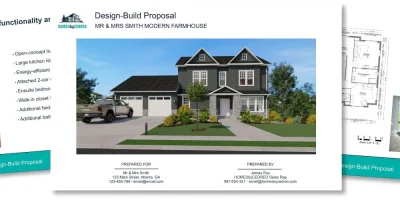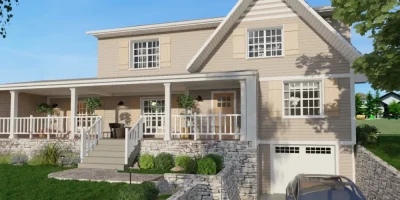
Win more bids and manage your business easier with best software for general contractors and contractors.
Software now plays a bigger role than ever in the day-to-day work of general contractors.
That’s why choosing the best general contractor software can make such a difference.
Well-designed project management, estimating, or accounting software keeps the job on track, while streamlined 3D design software like Cedreo helps you land bids faster with visuals clients can actually understand.
Choose wisely and you avoid project delays, estimate errors, and endless rework, all while landing more jobs, faster.
In this guide we’ll look at some of the best software for GCs, organized by category.
Key Takeaways
- The best general contractor software setup connects design, estimating, project management, and accounting so nothing falls through the cracks.
- Pick tools based on how you build, instead of on the longest feature list.
- Project management tools keep schedules, tasks, photos, and change orders organized, so contractors can keep construction projects moving without constant follow-ups.
- Cedreo design software helps contractors win approvals faster with quick but detailed floor plans and high-quality 3D visuals, so you can move from concept to estimate with less back-and-forth.
Why trust us? Here at Cedreo, we’ve got 20+ years of experience working with professionals in the home design space. We’ve seen firsthand the kind of software that helps general contractors design faster and land more jobs!
See How You Can Create Complete Projects with Cedreo
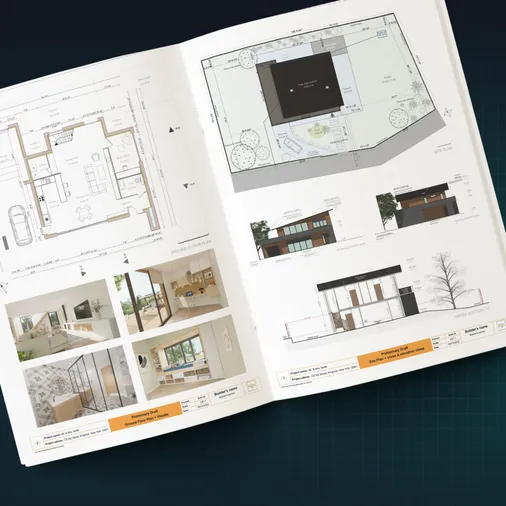
Plans – Get site plans, 2D floor plans, electrical plans, cross sections and elevation views — with all the technical details you need for a comprehensive project overview.
3D Visualizations – Use interior and exterior 3D renderings as well as 3D floor plans to help clients understand the finished project.
Documentation – Manage all your visual documents in one place, so it’s easier to present and sell your projects.
No credit card required, no commitment
What to Look for in the Best Software for Contractors
The right general contractor software should match how you run jobs, not just look good in a demo.
Use these checkpoints to compare construction management software, project management tools, estimating software, accounting systems, and design platforms.
Business Size and Job Mix
Small crews usually need simple scheduling, job costing, and client communication without a long setup.
Growing teams and multi-project builders often need stronger resource planning, permissions, and reporting across jobs.
Your Main Use Case
Start with the problem you want to fix, because each category solves a different headache.
- Design and presentations: Complete house plan sets and 3D visuals that help clients approve scope earlier.
- Project management: Scheduling, daily logs, tasks, punch lists, RFIs, and change orders.
- Document management: Plans, specs, photos, and approvals that stay version-controlled and easy to find.
- Estimating: Takeoffs, bid templates, vendor quotes, and margin controls.
- Accounting: Invoicing, payroll, purchase orders, and job costing that stays accurate.
Time Savings and Real ROI
Look for fewer double entries and fewer mistakes, because that is where most software pays you back.
If you still redraw plans or rebuild the same estimate in three places, a connected workflow can cut hours of admin every week.
PRO TIP! Track one job from lead to close inside a trial, then count how many handoffs still require retyping.
Software that lets you handle more steps of your workflow in a single place also saves you time since you don’t have to switch to and learn multiple platforms.
Ease of Use for the Whole Team
A clean mobile app or browser based access matters if your foreman has to update photos, time, or punch items from the field.
Role-based access helps office staff, subs, and supers see the right info without clutter.
Training resources (videos, templates, onboarding) reduce the learning curve and speed up adoption.
Support and Implementation
Fast support keeps projects moving when something breaks on bid day or during a change order.
Check hours, response times, and whether onboarding is self-serve or guided.
It’s also important to look for how easy it is to get help from a real person who knows what they’re doing instead of just relying on chat bots and user forums.
Integrations and Data Flow
Strong integrations reduce rework by syncing contacts, budgets, schedules, and documents between tools.
At a minimum, confirm it connects to your accounting software (often QuickBooks) and any CRM, calendar, or file storage you already use.
Browser-based tools can be convenient for client meetings and job sites, since you can log in from most computers without being tied to one machine.
When it comes to design software, see what file formats you can import and export so that you know it talks nicely to other programs.
Now let’s take a look at top general contractor software options in these categories:
- Design software
- Project management software
- Estimating software
- Accounting software
Best Construction Design Software for General Contractors
Construction design software helps you sell the job, lock scope, and hand cleaner details to your estimate and field team.
Instead of guessing off a sketch, you can show clients floor plans, elevations, and 3D renderings early, which cuts revisions and changes orders later.
Cedreo – TOP PICK!
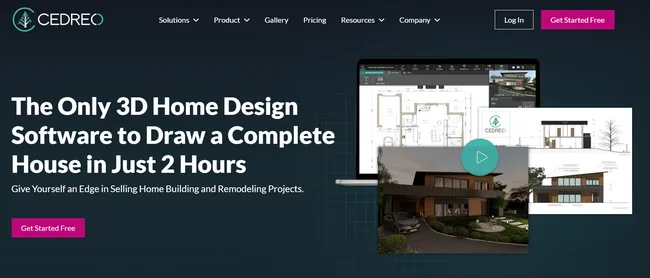
Best for: Residential builders and remodelers who want fast client-ready 2D + 3D without a CAD learning curve.
Cedreo is an online construction design software built for housing pros who need speed.
No other design program lets you do so much so fast.
You can draw floor plans, furnish spaces, and produce interior and exterior 3D visuals in minutes for client presentations.
It also supports site plan work, plus quick cross sections and elevations once the home and terrain are set.
Ease of Use (Learning Curve)
Cedreo is built for busy general contractors who want results fast.
- Intuitive workflow that is fast to learn for non-drafters.
- Most non-drafters can create a complete set of 2D/3D house plans in 2 hours.
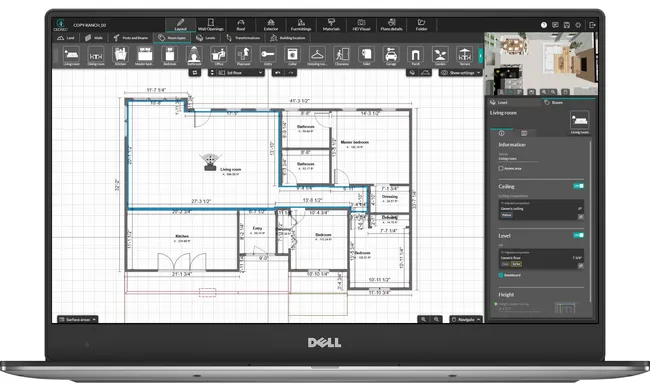
Floor Plan Tools
Cedreo floor plan software makes it quick to move from sketch to usable plans.
- Draw 2D floor plans with dimensions and surface areas.
- Trace over JPG/PNG/DWG/DXF when you start from existing plans.
- Site plans and terrain modeling tools
- Generate elevation and cross-section views
- Create electrical plans
3D Quality
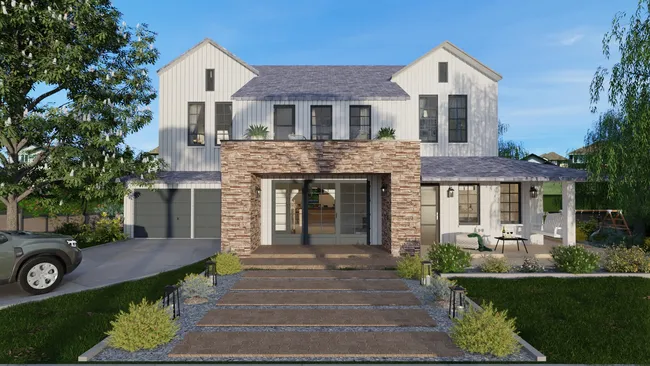
The 3D renderings are designed to look client-ready without extra tools.
- Photorealistic interior and exterior renderings with minimal setup.
- Adjustable sun orientation.
- Save views for before and after visuals.
- Adjustable lighting to show day or nighttime scenes.
Client Presentations
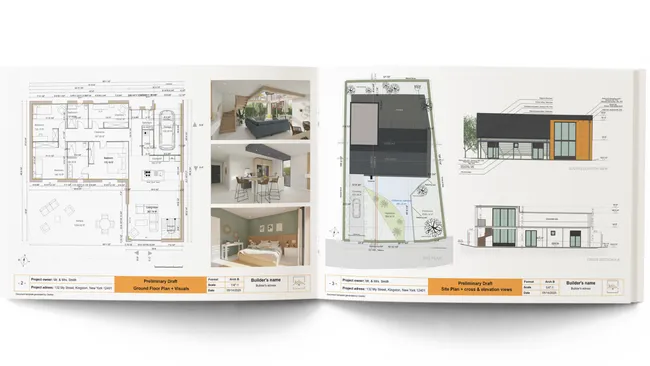
Cedreo helps you sell the work with project presentations clients understand.
- Combine 2D plans and 3D visuals, along with custom notes and company branding.
- Plans update automatically in the presentation as you make changes to the home design.
- No need to export images to another design software. Do it all in Cedreo.
Support
Support teams matter when you are building and bidding at the same time.
- Get responsive help from real people, not chat bots.
- Paid plans have access to a customer success manager they can contact via phone, email, or chat.
- The knowledge base and video tutorials help new users get up to speed fast.
Pricing: $$
Real user review from Software Advice:
“So simple to use and great with renderings” – Juan B. Architecture & Planning Professional
“Cedreo is a very user-friendly platform with exceptional features. We have been primarily using it for general contracting and interior design. Would highly recommend for any construction and or interior and architectural design firms entering the industry.” Sheree R. Construction Professional
Chief Architect
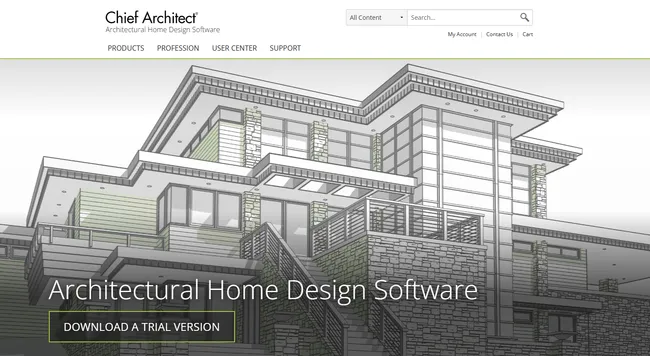
Best for: Design-build firms that need detailed construction drawings, schedules, and material takeoffs in one system.
Chief Architect is a powerful residential design and drafting tool that builds a 3D model as you draw.
As you place walls, doors, and windows, it can generate framing, roofs, and other building systems, as well as produce construction documents like site plans, framing plans, sections, elevations, and schedules.
If you do a lot of kitchen and bath work, its cabinet and catalog tools can speed up layouts and presentation images.
However all of this makes the software much more complicated to use and more time-consuming to create initial concepts, even for experienced users.
Key features:
- Automatic 3D model creation from 2D drafting.
- Construction document set tools (plans, elevations, sections, details).
- Material lists and schedules for takeoffs and job costing.
- Framing, roof, and foundation tools to reflect typical building systems.
- Rendering options (photorealistic and artistic styles).
Pros:
- Strong for permit-style drawing sets and detailed documentation.
- Built-in materials lists support faster estimating.
- Customizable for residential workflows.
- Works well for contractors who do in-house drafting.
Cons:
- Steeper learning curve.
- Higher cost.
- Some tools, such as the terrain modeling, are still clunky to use even for experienced users.
Pricing: $$$
SketchUp Pro
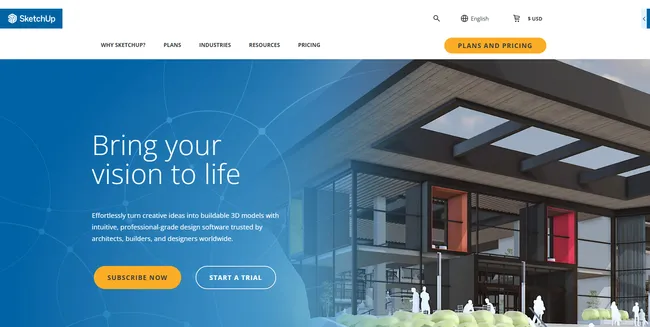
Best for: Contractors and 3D modelers who want flexible 3D modeling for concepts plus light documentation through LayOut and extensions.
SketchUp Pro is a 3D modeling platform that lets you model simple spaces quickly with 3D modeling tools.
Then you can pull scenes into LayOut for 2D pages like plans, elevations, and details.
Many builders lean on extensions for tasks like photorealistic rendering, estimating workflows, or construction document automation.
It can work well for modeling custom construction details; however, to create full document sets it requires a lot of manual work and meticulous model organization.
Key features:
- Desktop 3D modeler with the classic push/pull workflow.
- LayOut for 2D design documentation from model views.
- 3D Warehouse access for pre-built objects and components.
- Extension ecosystem to add rendering, reporting, and specialty tools (for extra cost).
- Import/export options that help coordinate with other design tools.
Pros:
- Fast for concept modeling with basic shapes.
- Huge library of extensions and 3D components.
- Widely used, so it is easy to find help and tutorials.
- Decent client-facing visuals when paired with a renderer.
Cons:
- More advanced 2D drafting and native rendering often require add-ons.
- Very large models can bog down performance.
- Creating designs with simple shapes can be fast but full building designs take a lot of manual work.
Pricing: $$
Construction design software comparison
| Software name | Best for | Pricing | Key features |
| Cedreo | Fast residential floor plans and 3D presentations without CAD | $$ | Web-based design, 2D plans, photorealistic 3D, site/terrain tools, elevations and cross sections |
| Chief Architect Premier | Detailed residential plans, takeoffs, and construction drawings | $$$ | Auto building tools, CDs, material lists, framing tools |
| SketchUp Pro | Flexible 3D modeling for concepts plus documentation via LayOut | $$ | 3D modeling, LayOut pages, 3D Warehouse, extensions, broad file compatibility |
Best Project Management Software for General Contractors
Project management construction software keeps your schedule, budget, team, and paperwork moving in the same direction.
It also gives you one place for daily logs, photos, RFIs, submittals, punch lists, and change orders, so the field and office stop chasing updates.
A good online portal also improves team communication and document sharing, so project managers and field teams stay on the same page across the entire project and save time.
Procore
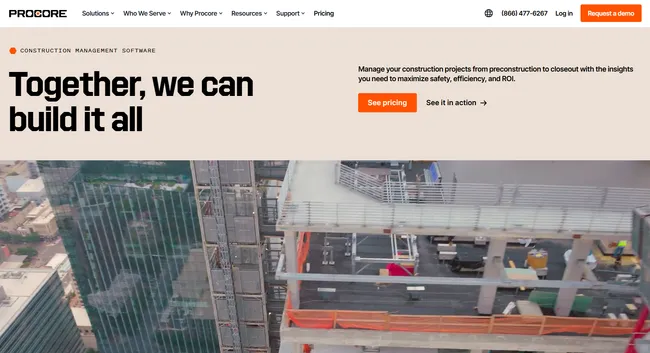
Best for: Mid-size to enterprise general contractors and construction companies who need a centralized construction management platform across many projects.
Procore is a full construction project management system that connects teams, drawings, documents, and financial workflows.
GCs use it to control document management, RFIs, submittals, and field reporting while keeping version history clean.
It can feel like a lot at first, but it shines when you need consistent processes across multiple jobs and stakeholders.
Key features:
- Centralized project hub for drawings, RFIs, submittals, and photos.
- Document management with revision tracking and permissions.
- Field tools for daily logs, observations, and punch lists.
- Change order workflows and approvals.
- Reporting and dashboards for project visibility.
Pros:
- Strong document control for complex jobs.
- Great collaboration between office, field, and subs.
- Scales well across many projects.
- Mobile tools support real-time field updates.
Cons:
- Can feel overwhelming for first-time users.
- Pricing can be high for small teams.
Pricing: $$$
Buildertrend
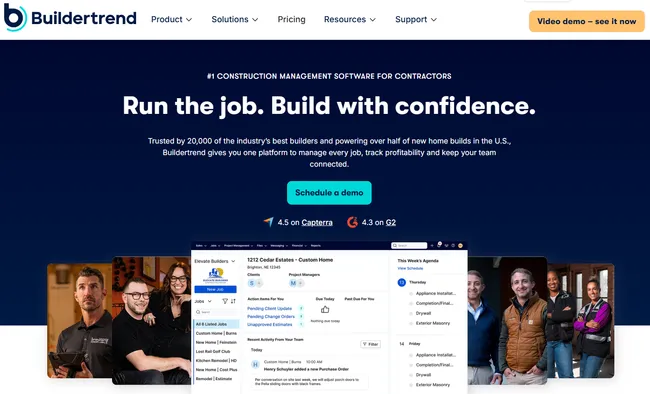
Best for: Residential builders and remodelers who want a client-friendly platform that covers scheduling, communication, and selections.
Buildertrend blends construction project management with a client portal, so homeowners can see progress and approve choices.
Many teams use it for scheduling, daily logs, budgeting, and change orders, plus tighter client communication.
If you live in the residential world, it can replace a pile of spreadsheets and email threads with one workflow.
Key features:
- Scheduling tools tied to tasks and job phases.
- Daily logs, photos, and field updates.
- Client portal for messages, files, and progress.
- Change order creation, approvals, and tracking.
- Budgeting and job costing tools with common accounting connections.
Pros:
- Strong client communication and transparency.
- Great fit for residential project workflows.
- Helps organize daily logs and job updates.
- Reduces back-and-forth with a shared portal.
- Good customer support.
Cons:
- Managing and tracking email communications can be challenging
- Budgets for large scale projects can be difficult to manage
Pricing: $$
Houzz Pro
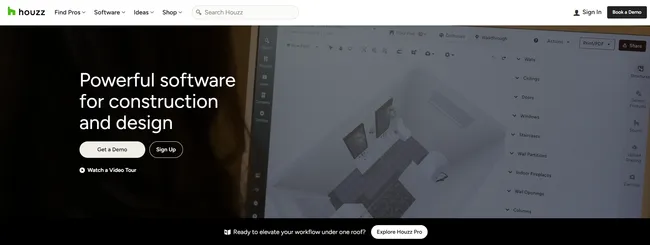
Best for: Solo contractors or small teams that want project management plus lead management, proposals, and a client-facing experience.
Houzz Pro is a popular solution that combines CRM-style lead tracking with project management features like scheduling, proposals, selections, and invoicing.
It can be attractive if you already use Houzz for marketing and want everything in one system.
Key features:
- Sales pipeline and client management tools to track the customer lifecycle.
- Estimates and proposals with client approvals.
- Scheduling and task planning for projects.
- Client portal for communication and project information.
- Integrations like QuickBooks Online and Google Workspace.
Pros:
- Good for solopreneurs and small teams.
- Combines leads, proposals, and project tracking in one platform.
- Helpful for firms that want a single system for sales to project handoff.
- Offers tools for client communication and visibility.
Cons:
- Can be hard for small teams and solo contractors to justify the price if they don’t immediately see ROI.
- Can be a lot to learn at first.
Pricing: $$
Project management software comparison
| Software name | Best for | Pricing | Key features |
| Procore | Larger GCs managing complex, multi-stakeholder projects | $$$ | Centralized project hub, document management, RFIs/submittals, field tools, reporting |
| Buildertrend | Residential builders and remodelers focused on client communication | $$ | Scheduling, daily logs, client portal, change orders, budgeting/job costing |
| Houzz Pro | Design-build firms that want leads + proposals + project tracking | $$ | Lead tracking, estimates/proposals, scheduling, client portal, QuickBooks/Google integrations |
Best Estimating Software for General Contractors
Estimating software helps general contractors bid faster, stay consistent, and protect margin.
Instead of rebuilding the same spreadsheet every time, you can standardize assemblies, run takeoffs, track vendor quotes, and turn approved scope into a budget you can manage.
Clear Estimates
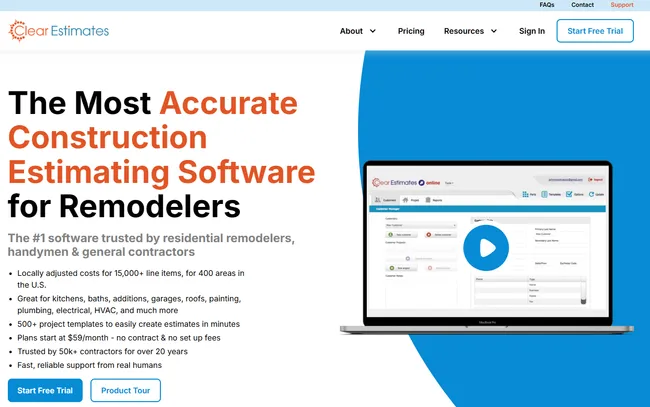
Best for: Residential remodelers and small general contractors who want fast, consistent bids with a strong template library.
Clear Estimates is an estimating software designed for remodelers that helps you build itemized bids quickly.
It includes a large line-item database and preloaded templates, plus quarterly labor and material rate updates.
On Pro plans, you can export estimates to Buildertrend and connect CRMs through Zapier, which helps your sales pipeline stay organized.
Key features:
- 13,000+ line item database and 200+ preloaded templates.
- Quarterly labor and material rate updates.
- Professional proposals and documents you can share with customers.
- Payable invoicing options.
- Integrations such as Buildertrend export (Pro) and CRM connections via Zapier (Pro).
Pros:
- Templates speed up repeat work like kitchens, baths, and additions.
- Pricing updates help you keep estimates current in a changing market.
- Pro integration with Buildertrend supports smoother handoff to project management.
- No contract with a 30-day free trial for testing.
Cons:
- Best fit is residential remodeling, not complex commercial estimating.
- Buildertrend and CRM integrations require the Pro plan.
Pricing: $$
Buildxact
Best for: Residential builders and remodelers who want estimating plus job management in one construction management software platform.
Buildxact is a cloud-based estimating and project management tool designed for residential construction projects.
It combines takeoff, estimating, quoting, scheduling, and cost tracking so general contractors can run more of the process in one place.
It also offers a client-facing online portal for sharing quotes, variations, and invoices, which helps keep customers informed without extra admin.
Key features:
- Digital takeoffs and estimating with templates.
- Quoting tools for professional proposals.
- Scheduling and job tracking to manage projects.
- Cost tracking and purchase orders to control budget.
- Accounting integrations plus invoicing workflows.
Pros:
- Helps general contractors reduce tool switching by using one platform.
- Supports both estimating and project management for residential jobs.
- Strong workflow from bid to completion, including purchase orders.
- Cloud access makes it easy to work from the office or job site.
Cons:
- Some users report a learning curve on advanced pricing and quoting steps.
- Scheduling interface can feel a little clunky
- No direct phone support option
Pricing: $$
STACK
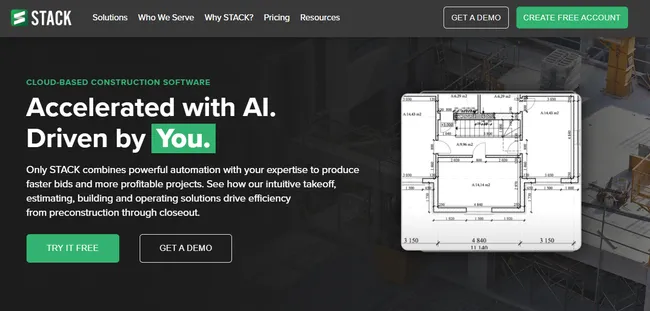
Best for: Teams that want cloud-based takeoff with collaboration, plus reporting for bids and budgets.
STACK is a cloud estimating and takeoff platform that supports shared plan sets and standardized workflows.
Estimators can run takeoffs from anywhere, then use templates and reporting to build bids faster.
It is a solid option for companies that want collaboration, consistent estimating, and fewer local installs to maintain.
Key features:
- Cloud-based takeoff with shared plan sets.
- Estimate templates and material/labor databases.
- Collaboration tools for teams working bids together.
- Reporting for bids, budgets, and audit trails.
- Integrations that support broader construction workflows.
Pros:
- Easy team collaboration on takeoffs.
- Works from anywhere with internet access.
- Standard templates improve estimate consistency.
- Helpful reporting for bid reviews and handoff.
Cons:
- Cumbersome to manually enter material prices.
- You need fast internet for it to work smoothly.
- No mobile app.
Pricing: $$
Estimating Software Comparison
| Software name | Best for | Pricing | Key features |
| Clear Estimates | Residential remodeling estimates with templates and quarterly pricing updates | $$ | Line item database, templates, quarterly updates, proposals, Buildertrend/Zapier options |
| Buildxact | Residential estimating plus job management in one platform | $$ | Digital takeoffs, estimating/quoting, scheduling, cost tracking, accounting integrations |
| STACK | Cloud takeoff and estimating for collaborative bid teams | $$ | Cloud takeoff, templates, collaboration, reporting, integrations |
Best Accounting Software for General Contractors
Accounting software keeps your books clean and your cash flow predictable, which matters just as much as the build.
For general contractors, the real win is job costing that stays accurate, so you can spot budget drift early and tighten up bids on the next project.
QuickBooks
Best for: Small to mid-size contractors who want familiar accounting with job costing and lots of integration options.
QuickBooks is widely used in construction because it covers core accounting like invoicing, expenses, and basic job costing.
Many contractor tools integrate with QuickBooks, which makes it easier to connect project management or estimating without rebuilding your entire process.
It works best when you set up cost codes or categories consistently, so job reports reflect reality.
Key features:
- Invoicing and payments tracking.
- Expense tracking and vendor management.
- Job costing and project tracking tools.
- Reporting for profit and loss, cash flow, and job performance.
- Integrations with many construction project management and estimating tools.
Pros:
- Familiar interface and large support community.
- Easy to connect with other contractor software.
- Strong baseline accounting for many residential GCs.
- Flexible reporting once your setup is clean.
Cons:
- Job costing accuracy depends on consistent data entry.
- Advanced construction accounting may require add-ons or a different platform.
Pricing: $$
Foundation Software
Best for: Contractors who need construction-specific accounting with deeper job costing, payroll, and reporting.
Foundation is built for construction accounting, so it goes beyond general bookkeeping.
It supports detailed job cost tracking, labor allocation, and reporting that fits contractor workflows.
If you have multiple crews and tight cost code control, it can offer more visibility than general business accounting tools.
Key features:
- Job costing with cost codes and detailed cost tracking.
- Construction payroll tools and labor burden tracking.
- Accounts payable and receivable built for contractor workflows.
- Reporting for WIP, job profitability, and cost analysis.
- Support for multi-company and multi-division accounting.
Pros:
- Built for construction job costing and payroll.
- Strong reporting for project performance.
- Handles complex cost code structures well.
- Better fit for contractors who outgrew basic accounting.
Cons:
- Setup and training can take time.
- May be more than a small GC needs.
Pricing: $$$
Sage 100
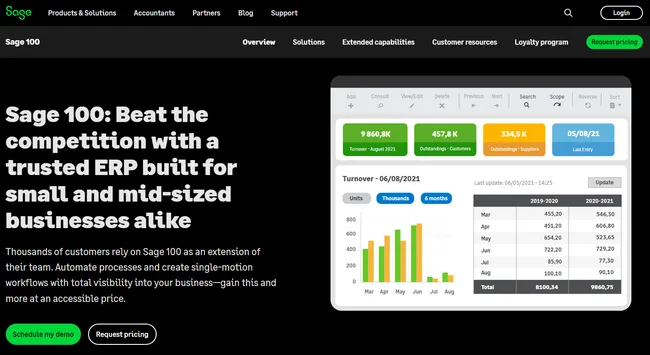
Best for: Growing contractors who want structured construction accounting with strong job cost controls.
Sage 100 is designed for construction firms that need disciplined job costing and accounting workflows.
It supports cost codes, commitments, and reporting that help keep budgets and actuals aligned.
Teams often choose it when they want a construction-first accounting backbone that can scale.
Key features:
- Construction-focused job costing with cost codes.
- Commitment tracking for purchase orders and subcontracts.
- Accounts payable/receivable plus invoicing workflows.
- Reporting tools for job cost, WIP, and financial performance.
- Options to connect with estimating and project management workflows.
Pros:
- Strong job cost controls for contractors.
- Helpful commitment tracking for budget management.
- Scales well for established construction businesses.
- Built around construction reporting needs.
Cons:
- Interface and workflows can feel dated to some users.
- Extensive software so it takes time to learn.
Pricing: $$$
Accounting software comparison
| Software name | Best for | Pricing | Key features |
| QuickBooks | Small to mid-size contractors needing flexible accounting + integrations | $$ | Invoicing, expenses, job costing, reporting, broad integrations |
| Foundation Software | Contractors needing construction-specific job costing and payroll depth | $$$ | Cost codes, construction payroll, AP/AR, WIP reporting, multi-entity support |
| Sage 100 Contractor | Growing contractors needing strong job cost control and commitments | $$$ | Job costing, commitments, AP/AR, WIP reporting, estimating/PM connections |
Why More General Contractors Choose Cedreo for Construction Design
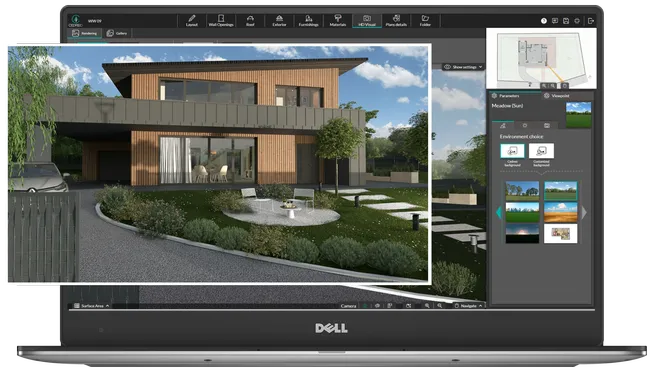
Cedreo fits the way residential general contractors sell and plan work, because you can move from idea to clear visuals fast.
It helps you get client approval earlier, then carry cleaner details into estimating and project handoff.
- Cloud-based access: Open your projects from the job site, a client meeting, or the office, as long as you have an internet connection.
- No CAD training required: Draw floor plans in minutes with contractor-friendly tools that feel more like building than drafting.
- Instant 3D visualization: Show interior and exterior 3D views during the first consultation, so clients understand the scope and say yes faster.
- Estimating workflow friendly: Export and share project details (such as surface area tables) so your estimating process stays smoother from concept through bid.
- Variety of export formats: Export in jpg, pdf, and dwg for compatibility with other programs.
Real user review from Software Advice:
“The product is quick to learn sufficiently to begin to produce design concepts. It produces strong renderings in 3D easy for a client to capture the essence of the design being proposed, so as to provide meaningful comment for further design development.” – James M, Architecture & Planning Professional
Which Software Is Right for Your Contracting Business?
The best setup is the one that removes friction from your full job cycle, from first call to final invoice.
If you run residential projects, your fastest wins usually come from tighter handoffs between design, estimating, scheduling, and job costing.
Before you commit, make sure your stack can do these three things well:
- Help clients approve decisions faster with clean visuals and easy communication.
- Keep scope changes controlled with clear documentation, approvals, and history.
- Reduce double entry by syncing numbers between estimating, project management, and accounting.
If you want to streamline early-stage design and speed up client approvals, start with Cedreo.
General Contractor Software FAQs
What software do most contractors use?
Most contractors and general contractors use a mix of project management, estimating, and accounting tools, as well as a design tool.
Cedreo often fills the design piece by making it easier to present clear floor plans and 3D visuals early.
What is the best estimating software for general contractors?
The best estimating software is the one that matches your workflow, whether you need fast takeoffs, strong templates, or tight budget tracking.
Clear Estimates, Buildxact, and STACK are popular options for estimating software in the construction industry.
What is the best accounting software for general contractors?
For many contractors, QuickBooks is a practical starting point because it is widely supported and integrates with other tools.
Foundation and Sage 100 are popular options for large construction firms and their financial management.
Do general contractors need design software?
You do if you build or remodel homes and want faster approvals with fewer revisions.
Cedreo design software helps by turning ideas into clear 2D plans and 3D views that clients understand right away.
What is the difference between project management and design software for contractors?
Project management software runs the job (schedule, tasks, RFIs, daily logs, change orders), while design software defines what you are building.
Cedreo sits on the design side, and more GCs are using Cedreo since it shortens the time to proposal so contractors can land jobs faster.
What is the easiest design software for contractors to learn?
The easiest design software is the one that lets you draw and present without a CAD-style learning curve.
Cedreo is one of the easiest software for GCs because it focuses on fast floor plans and presentation-ready 3D rather than complex drafting commands.
How does 3D design software help contractors win more jobs?
3D visuals reduce confusion, build trust, and help clients commit faster because they can see the finished space.
The best 3D design software, like Cedreo, supports that sales process by allowing you to go from idea to complete 3D design, while your competitors are still drafting the floor plan.